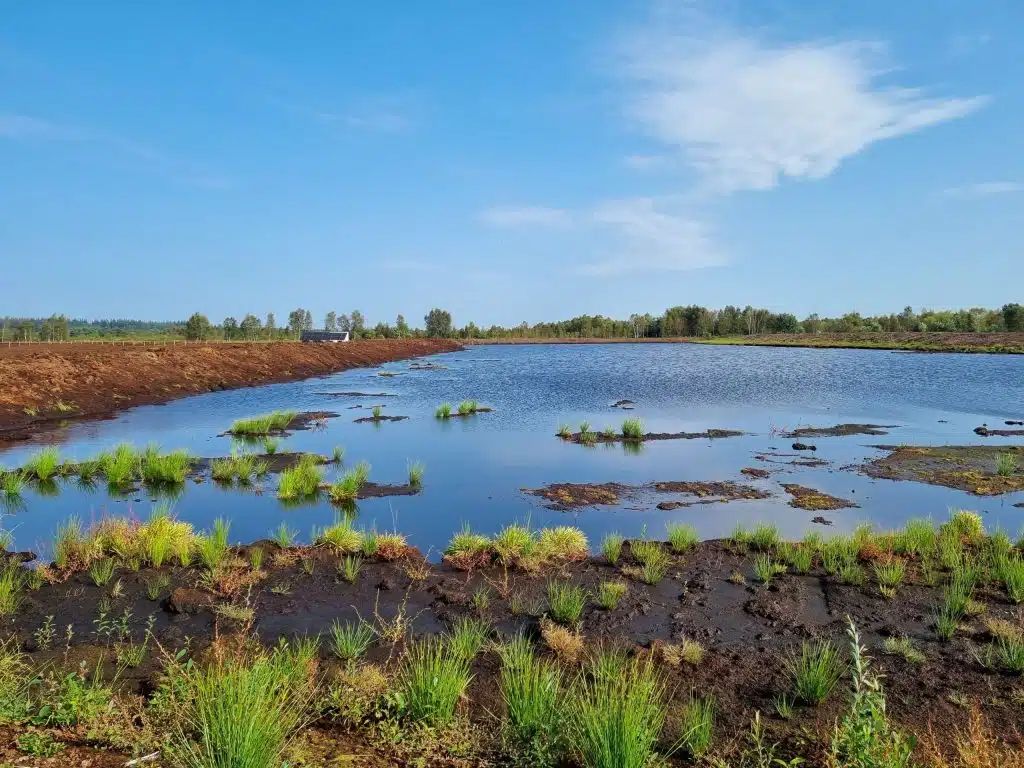
Photograph of the Ahlen-Falkenberg moor. Water surface surrounded by trees and grass.

Sustainability

27 August 2024

NABU climate fund: NABU and REWE are taking stock of the initial success

By the end of the year, twelve million Euros will be invested in the renaturalisation projects

Reading time: 5 min.

In order to achieve Germany’s climate targets, degraded peatlands used for agriculture need to be rewetted. However, the restoration of peatlands in Germany is currently making slow progress. This is why NABU, together with its cooperation partner REWE, established the NABU Climate Fund in 2022. With investments of at least 25 million euros, nature-based climate protection projects are being promoted.

NABU and REWE are now taking stock of their initial success. Since the start of the project, almost 3,200 hectares of moorland have been secured for rewetting. A further 1,100 hectares will be added by the end of the year. By then, around twelve million euros will have been channelled into the renaturation projects. In total, the NABU climate fund comprises seven projects in five European countries.

NABU President Jörg-Andreas Krüger: Peatlands make up only a small part of the earth’s surface, but are indispensable for a healthy climate and our ecological balance. To achieve this, we need to restore them to a good condition. In the NABU Climate Fund, we are leading the way together with our trusted partner REWE and making a concrete contribution to the fight against the climate crisis and the loss of species and ecosystems.

One of these projects is the rewetting of the “Ahlen-Falkenberger Moor” in the district of Cuxhaven with an area of around 200 hectares of degraded, agriculturally utilised raised bog. With an investment of around six million euros, the moor is to be restored to its natural state in the coming years. This will save almost 200,000 tonnes of CO2 in greenhouse gas emissions over the next 25 years.

Dr Daniela Büchel, Member of the Management Board of REWE Group: Global warming and species extinction are the two biggest ecological crises of our time – and they have a direct impact on us all. We see ourselves as having a clear responsibility here and want to make our contribution. That is why it is very important to us to voluntarily support climate protection projects in addition to our massive commitment to reducing emissions. The project in the Ahlen-Falkenberger Moor near Cuxhaven is Europe’s largest renaturalisation project of an agriculturally used raised bog. It is an example of the important work that the NABU Climate Fund is doing to protect the climate and restore natural habitats.
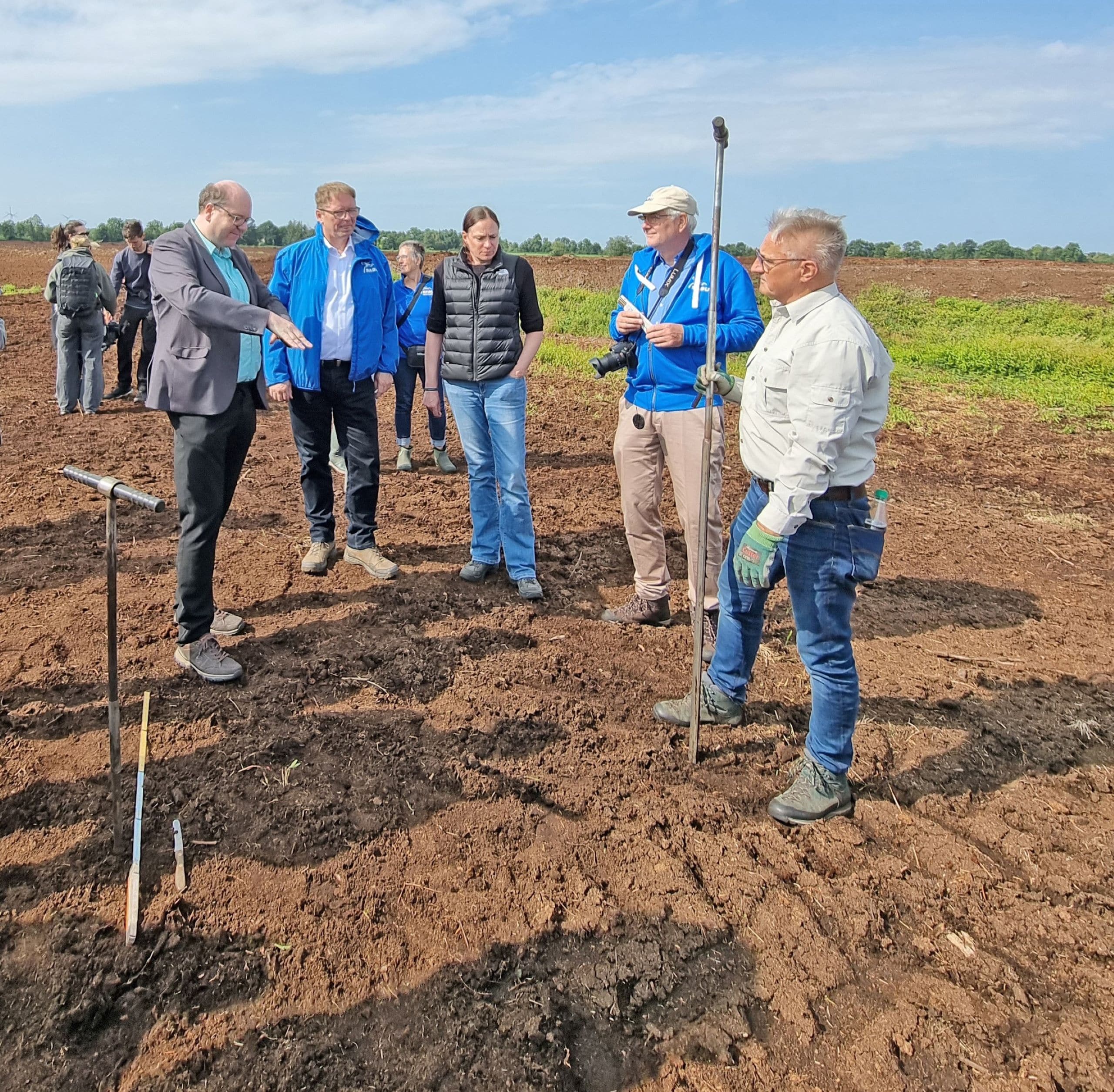
Christian Meyer, Lower Saxony’s Minister for the Environment, Energy and Climate Protection, NABU President Jörg-Andreas Krüger and REWE Group Board Member Dr Daniela Büchel (from left to right) had the moorland restoration measures explained to them at an on-site meeting.

In the Ahlen-Falkenberger Moor, the topsoil used for agricultural purposes is being removed, among other things. Drainage channels are closed and ditches filled in to stop water run-off. This is the only way to restore the raised bog vegetation typical of the landscape. In addition, the area will be used to grow its own peat moss with a water reservoir.

Christian Meyer, Lower Saxony’s Minister for the Environment, Energy and Climate Protection: As a leading peatland state, Lower Saxony has a special responsibility for climate protection and nature conservation. We want to reduce annual greenhouse gas emissions from carbon-rich soils by 1.65 million tonnes per year by 2030. Agricultural use and peat extraction have greatly changed our moors over the last two centuries. By systematically restoring these ecosystems, they can once again make a valuable contribution to climate protection and provide a diverse habitat for animal and plant species. The rewetting project by NABU and REWE in the Ahlen-Falkenberger Moor is an exemplary demonstration of how the protection of our biodiversity and the reduction of greenhouse gas emissions go hand in hand.

The project is being supervised in cooperation with the local NABU group Land Hadeln and the Moor Information Centre (MoorIZ). The documentation of water levels and samples, the recording of vegetation and the mapping of breeding birds are being carried out in collaboration with the Institute for Landscape Ecology at the University of Münster.

About NABU

  • With more than 940,000 members and supporters, NABU, founded in 1899, is the oldest and largest environmental organisation in Germany. NABU is committed to the preservation of habitat and species diversity, climate protection and the sustainability of agriculture, forestry and water management. NABU’s central concerns also include the mediation of nature experiences and the promotion of natural history knowledge. More information: en.nabu.de/about

About REWE

  • With sales of 31.6 billion euros (2024), more than 170.000 employees and over 3,800 REWE stores, REWE Markt GmbH is one of Germany’s leading food retail companies. REWE stores are run as subsidiaries or by independent REWE retailers.

    The cooperatively organised REWE Group is one of the leading trade and tourism groups in Germany and Europe. In 2024, the company generated a total external turnover of around 96.1 billion euros. Founded in 1927, the REWE Group has around 380,000 employees and operates in 21 European countries.

thomas-bonrath

Contact

Thomas Bonrath

Head of Media Relations and Spokesperson REWE Markt

Join the discussion on

Our LinkedIn feed has all the latest information from the REWE Group and the sector, with the most important developments from the worlds of retail, e-commerce, food, CSR and policy.