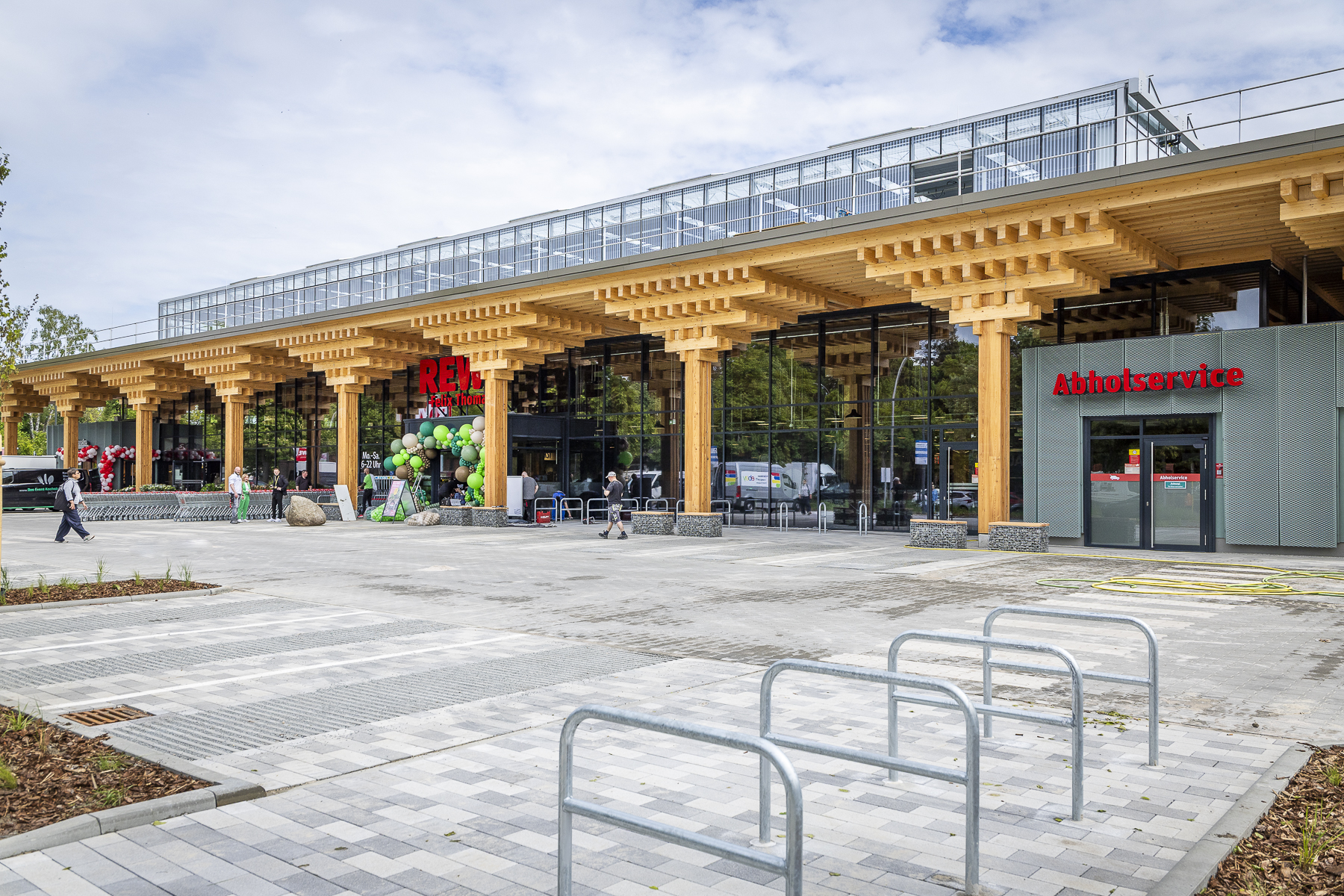
A supermarket that sets new standards – both ecologically and architecturally – is currently being built in the Berlin district of Lankwitz. At the end of September, the second REWE Green Farming market celebrated its topping-out ceremony, bringing it a big step closer to its opening in spring 2026. What makes it special is that it is the first REWE GROUP market to be planned and built entirely using the BIM (Building Information Modeling) method. In this interview, Thomas van der Broeck, Head of Digital Construction & Processes, explains why the project is groundbreaking for construction at the REWE GROUP.
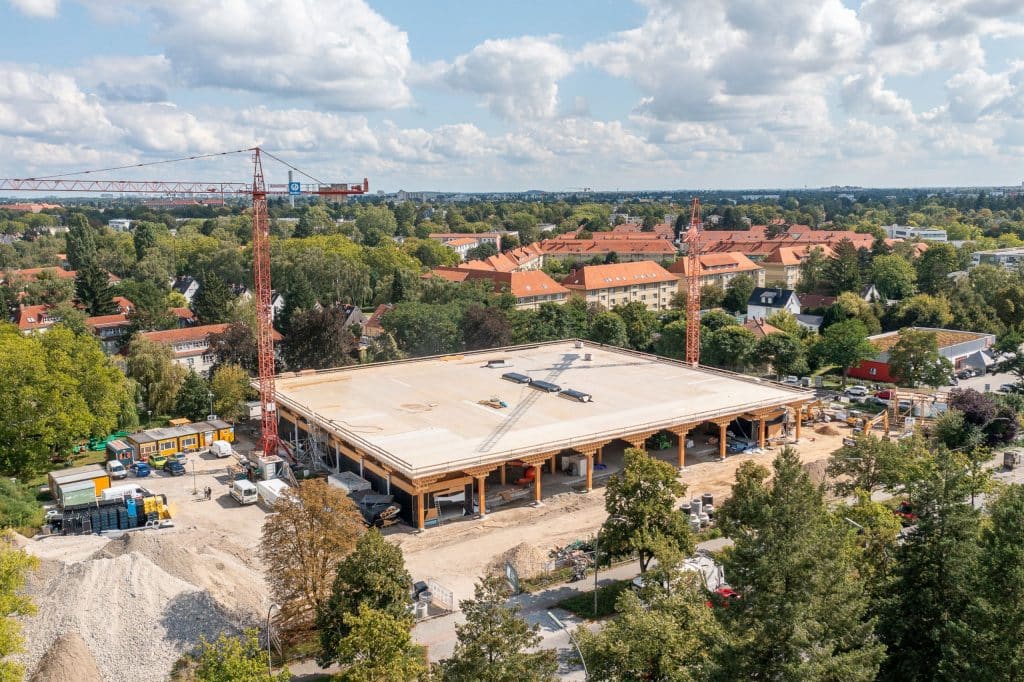
REWE Green Farming Berlin: Agriculture on the roof and digitalization in the foundation
Insights into REWE Group's first construction project with a digital twin
Reading time: 7 min.
On September 17, 2025, a milestone was celebrated in Berlin-Lankwitz: the topping-out ceremony for the second REWE Green Farming Market marks the progress of a project that is setting new standards not only with its rooftop farm but also with its digital planning. Since construction began in March, the supporting structure has been built from around 1,450 cubic meters of local softwood – a recyclable construction that stores CO₂ and does not require any glue joints.
Berlin’s largest rooftop farm is being built above the 2,150-square-meter market hall. The Berlin-based company ECF Farmsystems will produce up to 900,000 salad mixes there annually – in an automated, hydroponic system, almost without soil and independent of weather and season. Rainwater from a cistern and the use of waste heat to heat the market complete the sustainable cycle.
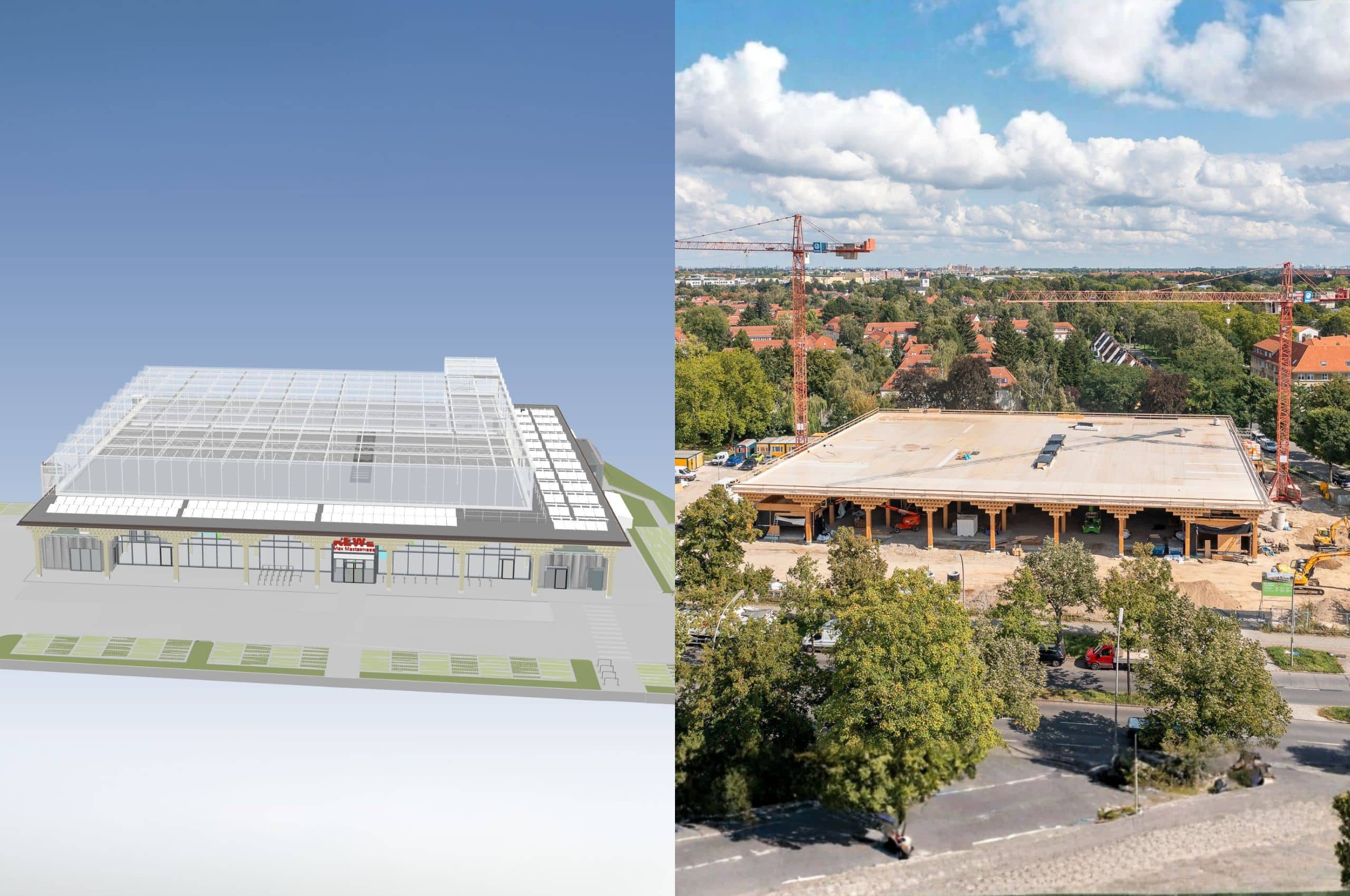
But not only ecologically, also in the planning the store is a pioneer: It is the first REWE store to be planned entirely using the BIM- method.
“We are building the digital twin at the same time”
But the store is not only a pioneer in terms of ecology, it is also a pioneer in terms of planning: it is the first REWE store to be planned entirely using the BIM method. Thomas van der Broeck explains what this means in an interview.

About:
Thomas van der Broeck
Head of Digital Construction & Processes REWE GROUP
What does “BIM” actually mean?
BIM stands for Building Information Modeling. It is a new working method that lays the foundation for the digital twin of a property. Instead of planning in two dimensions as before, we are now planning in three dimensions for the first time, in a data-driven and, above all, collaborative manner. This means that all those involved in the planning process contribute their own model, which is then linked to the models of the other trades and automatically checked for collisions. The overall model then forms the data foundation for all further processes.
What does this mean specifically for the planning and construction process?
The building is constructed digitally in advance. The entire planning process becomes more transparent for everyone involved. We identify problems before they arise and usually become expensive on the construction site. For example, if a ventilation duct does not match the wall opening, this would often only have been noticed on the construction site in the past. Today, we can see this directly in the model and resolve it in advance. In the long term, this allows us to gain significantly in terms of speed and data quality and avoid additional costs during the construction phase.
What happens after construction – what happens in the operating phase?
The BIM model accompanies us throughout the entire life cycle of the property. In the operational phase, it forms the basis of the digital twin, which is created by linking all relevant information, such as the materials used and technical systems installed. This will bring enormous advantages in the future, especially for the maintenance and repair process. An example: Until now, before traveling to a store, tradespeople only knew that they had to replace a filter in a ceiling unit (heating/air conditioning). However, there may be up to 15 of these units. In the digital twin model of a store, tradespeople will be able to see exactly which device has a problem and what they need to bring with them for repair or maintenance. This saves time, travel, and resources.
Why was the Green Farming Construction project in Berlin chosen as the first market to use BIM?
REWE Green Farming is not a flagship project in Berlin and Wiesbaden, but rather a forward-looking concept that is going into series production and is to be built at many other locations. It therefore makes sense to focus directly on a new method so that it can be implemented, established, and further developed as standard practice. In the Green Farming Berlin project, my colleague Demet Bachor, in her role as BIM manager, provided intensive support to regional colleagues from the construction department and specialist planners, highlighting the potential opportunities. The insights gained are now being incorporated into other BIM projects in other business units of the REWE GROUP.
Since October 1, 2025, you have been leading a newly created team for digital construction in the REWE GROUP’s construction division under Harald Fischer – the ‘Digital Construction & Processes’ department. What is the REWE GROUP’s vision for the future of construction?
Even though the future of a trading company is not primarily shaped by construction, we still want to make our contribution in this area. Our goal is to move away from paper-based processes and isolated solutions—towards a fully digital portfolio of our real estate assets.
Looking at a property over its entire life cycle, we still have a lot of potential. One example is the gradual digitization of existing properties using AI-based technologies – we are basically just getting started here. At the same time, we see the consistent digitization and automation of our processes as an opportunity to actively counteract rising cost pressure and the shortage of skilled workers.